
EU & US Sportswear Regulations: What Brands Must Know
Time to read: 4 minutes
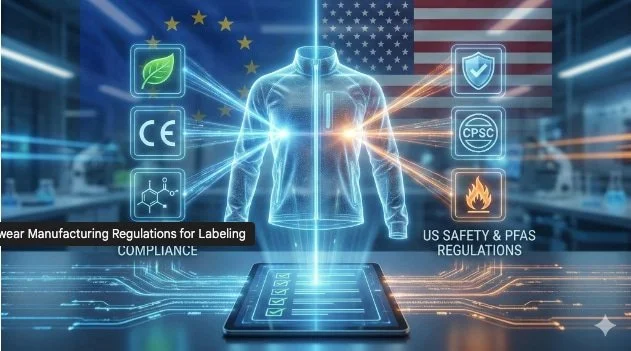
If you are developing sportswear for the EU or US markets, navigating sportswear manufacturing regulations is no longer an afterthought—it is a core part of the design process. To avoid costly recalls, customs delays, or legal action, there are five major regulatory categories you must understand before you begin production.
Let’s break them down.
1. Safety-Focused Sportswear Manufacturing Regulations
In the EU, the core regulation is the General Product Safety Regulation (GPSR). In the US, the foundation is the Consumer Product Safety Act (CPSA), enforced by the CPSC.
The fundamental rule across both markets is that your sportswear must not pose consumer risks, must not contain unsafe components, and must be entirely safe under normal, foreseeable use. If a product is found unsafe, authorities can issue mandatory recalls and require brand notification within 24 hours.
Common safety red flags to engineer out of your designs:
Sharp fasteners or exposed metal edges.
Weak trims that could break off and become choking hazards.
Unsafe design features (like unsecured or overly long drawstrings).
Material risks (such as highly flammable synthetic blends).
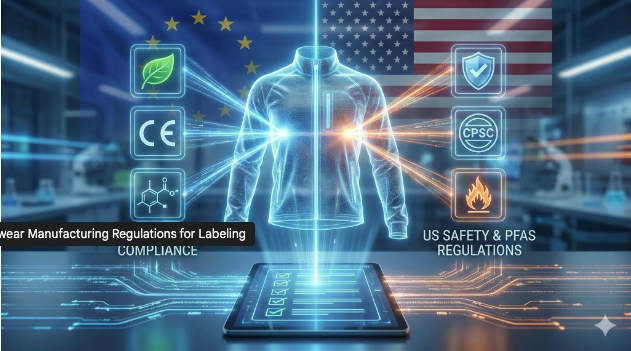
2. Navigating Sportswear Manufacturing Regulations for Labeling
Your garment's label is its legal passport. It must accurately reflect exactly what the garment is and where it came from to comply with international sportswear manufacturing regulations.
US Requirements
Governed by the Textile Fiber Products Identification Act and the FTC Care Labeling Rule, your labels must clearly display:
Precise fiber content and percentages.
Country of origin (e.g., "Made in Vietnam").
Manufacturer or importer identity (such as your RN number).
Accurate care and washing instructions.
EU Requirements
Under the GPSR and related legal frameworks, EU labels must include the following:
Contact details for your EU Responsible Person.
A clear product identifier (such as a Batch, Serial, or PO number).
Risk-based warnings (if applicable).
Translated labels reflecting the official language(s) of the specific country of sale.
3. Chemical Regulations
In the EU, chemical compliance is heavily governed by REACH (Registration, Evaluation, Authorisation, and Restriction of Chemicals). If you do not have total visibility into your supply chain chemistry via a highly detailed Bill of Materials (BOM), you are exposed to massive hidden liability under modern sportswear manufacturing regulations.
This sweeping regulation affects almost every physical component of your garment, including:
Fabric dyes and colorants.
Performance finishes and chemical treatments (like DWR waterproof coatings).
Heavy metals used in zippers, buttons, and hardware.
Screen prints, coatings, and flame retardants.
4. Category-Specific Scrutiny
Depending on your specific niche, you may face additional layers of scrutiny built into sportswear manufacturing regulations.
Kids’ Sportswear: Subject to incredibly strict safety rules, particularly regarding drawcord length restrictions and small-part choking hazards.
Sportswear with Electronics: Heated jackets or garments with wearable tech may fall under RoHS (Restriction of Hazardous Substances) in the EU and require additional electrical compliance certifications.
5. Circularity and Future Sportswear Manufacturing Regulations
The era of "take-make-dispose" is ending. The EU’s Ecodesign for Sustainable Products Regulation (ESPR) shifts the legal focus from basic safety to lifecycle design. With specific textile rules rolling out via Delegated Acts between 2026 and 2027, brands must prepare for
Mandatory durability and repairability standards.
Required recycled content thresholds.
Financial incentives for recyclability.
Strict restrictions on chemical substances that prevent a garment from being recycled.
The Digital Product Passport (DPP) expected to become mandatory for textiles in the EU around 2027; the DPP will require complete supply chain traceability. Each garment will likely require a QR code or RFID tag linking to data on:
Exact fiber composition and any substances of concern.
The garment's overall environmental footprint.
Clear repair guidance and end-of-life disposal instructions.
Ban on Destruction of Unsold Goods (EU): Effective July 2026 for large enterprises (and rolling out later for medium enterprises), brands will be legally prohibited from destroying unsold inventory. Instead, they must:
Reuse, repair, refurbish, or recycle the goods.
Publicly disclose their discarded volumes on an annual basis.
What About the US? While the US currently lacks a federal DPP or durability mandate, Extended Producer Responsibility (EPR) laws are gaining rapid momentum at the state level. For example, California's textile EPR requires brands to join a Producer Responsibility Organization (PRO). Future fees may be "eco-modulated"—meaning brands that design for durability and recyclability will pay less, while fast-fashion polluters will pay more.
Conclusion
Navigating sportswear manufacturing regulations is a fast-moving target, particularly in the EU. Brands that wait until 2027 to prepare will face a severe operational shock. The brands that are winning tomorrow’s market are acting today by:
Improving raw material traceability.
Simplifying their material blends.
Strengthening their factory documentation.
Engineering durability directly into their tech packs.
Compliance is no longer optional. It’s strategic.
Want Help Building a Compliance-Ready Development Process?
If you want support creating tech packs that are built for real-world production and need help keeping your team aligned on materials, labeling, and compliance documentation, Tech Packs Co can help.
Our team works with fashion and sportswear brands to turn complex development processes into structured, production-ready systems. That means clearer BOMs, stronger supplier communication, better documentation, and fewer compliance surprises down the line.
Book a consultation with us today and develop your next collection with total confidence.





Author Bio
Tech Packs Co founder Belinda is a technical fashion designer from London, now based in Los Angeles. Belinda had her first job in fashion at the age of 15, fixing swatch cards together. Since then, Belinda has been designing & creating tech packs for more than a decade... for household name brands and independent designers alike.